

Open Access (OA) provides unrestricted online access to scholarly information, enabling anyone to read, use, and share research without financial, legal, or technical barriers.
Any kind of digital content can be OA, from texts and data to software, audio, video, and multimedia. While most Open Access content has traditionally focused on text, an increasing number of resources combine text with images, data, and executable code. Open Access can also apply to non-scholarly content, such as music, films, and novels.
A publication is considered to be Open Access if it complies with one or more of the following conditions:
Open Access can benefit researchers, practitioners, policymakers, and society more broadly by making research findings easier to access and reuse.
For researchers:
For citizens and society:
Publications arising from projects funded by the Spanish Ministry of Science, Innovation and Universities (Knowledge Generation Projects) or the European Commission (Horizon Europe) must comply with the funder’s Open Access requirements to be reported as official project outputs.
Before signing any publishing agreement, ensure the publisher allows the immediate deposit of the Author Accepted Manuscript (AAM) in the IE University Institutional Repository with no embargo period. This requirement applies to both Open Access and subscription journals, regardless of the journal’s ranking or publishing model.
If applicable, please remember to acknowledge any relevant funders and grant information during the publication process.
Following Open Science requirements, the main European and Spanish research funding bodies stipulate that publications resulting from funded research must be deposited in open access, along with the data necessary to validate them.
Main statements:
Horizon Europe is the research and innovation (R&I) framework program of the European Union (EU) for the period 2021 -2027. It involves open science and citizen science. It is committed to guaranteeing open access to research data following the principle “as open as possible and as closed as necessary.” You can access the Participant Guide. prepared by the Center for Industrial Technological Development (CDTI), included in the Spanish Portal of the European Research Framework Programme.
Emphasizes the value of science as a common good and advocates for open access to publicly funded research outputs. Article 37, “Open Science,” promotes the development of open infrastructures and platforms, requires the open access through archive of publications, data, codes, and methods in repositories, and encourages the open participation of civil society in scientific processes.
Plan Estatal de Investigación Científica, Técnica y de Innovación 2021-2023 (PEICTI), following the objectives stated by the Estrategia Española de Ciencia, Tecnología e Innovación 2021-2027(EECTI).
The Spanish Science, Technology, and Innovation Strategy (EECTI) 2021-2027 makes a commitment to open science in its objective 4 “Knowledge generation and scientific leadership,” as well as in action axis 14 “Science and innovation in society”. Similarly, the State Scientific, Technical, and Innovation Research Plan (PEICTI) 2021-2023 includes different initiatives within the State Subprogram for Institutional Strengthening aimed at implementing open and inclusive science models.
Ley Orgánica 2/2023, de 22 de marzo, del Sistema Universitario. Artículo 12.
Strengthens the mandate of open access of all research outputs in the university open institutional repository.
Estrategia Nacional de Ciencia Abierta 2023-2027 (ENCA)
Building upon the previous Spanish statements, ENCA aims to ensure that by 2027 the funding, execution, communication, and assessment processes of scientific research in Spain incorporate the principles of open science.
It focuses on the following pillars:
IE University recommends our affiliated researchers to self-archive their scientific articles after they have been published in our institutional Repository. Also, Doctoral dissertations must be published openly with a selected Creative Commons License.
Before your first submission:
When submitting your manuscript:
When submitting a revision:
Before signing your publishing agreement:
When making your funding acknowledgement:
Choosing a licence and uploading to the repository:
Transformative Agreements (TAs), also known as Read & Publish agreements, are contracts between institutions (such as universities or library consortia) and publishers that combine the cost of reading subscription-based journals with the ability to publish a certain number of articles in Open Access.
These Transformative Agreements represent a new model in which institutions not only gain access to the publisher’s journals but also cover the cost of publishing research outputs openly, helping to make scientific knowledge freely available to everyone.
In 2021, CRUE-CSIC has arranged their first agreement with the aim of advancing the socialization of knowledge through increasing free access to it. This changes the traditional model academic subscription into a sustainable and open system.
At the IEU Library, our researchers can publish a limited number of articles in selected journals covered by these agreements without assuming the cost of the APC. We manage these requests in collaboration with the Research Department.
If you need support or wish to check whether your journal is included in one of our Transformative Agreements, please contact us at openaccess@ie.edu.
The IE University Library, in collaboration with the Research Department, manages APC requests for IE University researchers. Funding is provided through a limited annual allocation of credits under each transformative agreement, used to cover the APC cost for each approved publication.
In the following table, you can find a breakdown of the main publishers with a stablished transformative agreement, together with further information about each publisher and relevant Open Access policies.
Wiley and CRUE-CSIC have an agreement that allows eligible authors to publish open access articles without paying an article publication charge (APC). The cost of publishing is covered under the terms of the agreement. Corresponding authors affiliated with participating CRUE-CSIC institutions may publish gold open access in any fully open access* or hybrid journal, free of charge**. By choosing gold open access an article is immediately and freely available for all to read, download and share.
Wiley’s eligibility requirements:
Elsevier and the Crue Spanish Universities-CSIC Alliance have established an agreement to support authors in Spain who wish to publish open access. The cost of publishing open access is covered under the terms of this agreement. Eligible corresponding authors do not have to pay an article publishing charge (APC).
From now on, Elsevier will offer Unlimited number of APCs on hybrid journals.
To support authors in publishing open access (OA), Springer Nature partners with institutions globally to provide flexible agreements that help cover OA publication costs (known as article processing charges, or APCs).
Sage has an agreement with the IE Universidad to publish articles open access. The agreement for participating organizations will run from January 01, 2025 through to December 31, 2025. The details of the agreement are as follows:
To qualify for the agreement, the corresponding author must be affiliated with IE Universidad and have an article accepted for publication between January 01, 2026 and December 31, 2026.
Gold open access journals: Corresponding authors publishing an article in a Gold open access journal are entitled to a 15% discount on the prevailing article processing charge (APC) for that journal. For participating journals view the gold journal title list. This discount will be applied automatically in Sage Journals: Licensing & Payment. Where an author is eligible for more than one discount, discounts cannot be combined but the highest discount available to the author will be applied to the APC due.
The corresponding author must be affiliated with IE Universidad for their article to qualify for the article processing charge (APC) discount.
Authors do not need to take any action to benefit from this offer. Sage will contact all eligible authors to inform them of the agreement and invite them to Sage Journals: Licensing & Payment to take up the offer as soon as their accepted article has been received into Sage’s Production department.
If you are affiliated with IE University you can publish your article Open Access (OA) – at no cost to you – in gold and hybrid journals. In addition, you can enjoy access to Cambridge University Press journals content.
Easily check your eligibility to publish OA under this agreement, and the journals available to you, by using our eligibility checker tool.
To be eligible, articles must:
If you want to look for a specific journal, the Library has created a document that highlights top and premium journals that feature transformative agreements, organized by publisher. This list aims to support researchers identify high-impact publication opportunities supported by our Open Access arrangements. You can explore the full list here.
IE UNIVERSITY REQUIREMENTS
Mandatory:
Once your APC request has been submitted, the IEU Library will receive a notification, starting the evaluation process. During this process, the Research Department will review your request to determine whether the Article Processing Charge (APC) can be approved, based on the eligibility criteria and the availability of APC credits at the time of submission.
Once the APC eligibility check has been completed, the publisher’s system will send you the corresponding notification, usually via their submission platform, indicating whether the APC has been covered under the agreement or not. If the request is not approved, the APC will need to be covered by the researcher, typically through their research group or project funding.
Please, remember that you must deposit a copy of the publication in the IE Repository.
Other considerations:
Whether the Article is published in a Top or Premium IE Journal (Highly recommended)
The specific funding and its Open Access requirements
Where the Journal is indexed.
After consideration on the budget available.
*The approval will be made by the Research Office.
Where the number of APCs available under an agreement is limited, requests will be processed on a first-come, first-served basis until the annual APC allocation has been exhausted.
There are different ways to publish Open Access. Different routes correspond with the different requirements of the funders/institutions and the guidelines of the journal publisher, as well as the author´s preference.
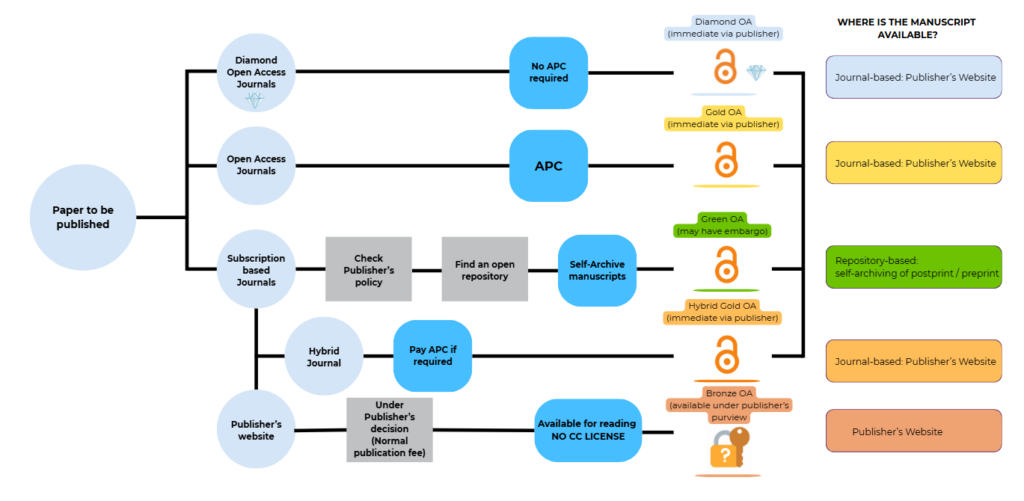
Some forms of open access involve paying an Article Processing Charge (APC). Others do not require payment but may impose conditions such as limits on which version can be shared, embargo periods, or restrictions on where the work can be deposited. These different routes to open access are often categorized using a color system, explained in the image below:
The Diamond Open Access model ensures that the final published version of an article is freely and permanently available to everyone immediately after publication. Under this model, most access and reuse restrictions are removed, while authors typically retain copyright of their work.
In Diamond Open Access, publishing and dissemination costs are covered through alternative sources such as institutional support, grants, or subsidies. Unlike other open access models that rely on Article Processing Charges (APCs), Diamond OA eliminates financial barriers for both authors and readers, allowing researchers to publish and access scholarly work at no cost.
The Gold Open Access model makes the final published version of an article freely and permanently available to all readers immediately upon publication. Under this model, most access and reuse restrictions are removed, while authors generally retain copyright of their work. Articles published through Gold Open Access may appear in either:
Hybrid OA is a subscription journal with open access to individual articles usually with an “Article Processing Charge”. Characteristics include:
Also referred to as self-archiving, Green Open Access involves depositing a version of a manuscript in a repository so it can be made freely available to readers. In most cases, the publisher retains copyright, meaning that specific conditions apply regarding which version can be shared, where it may be deposited, and when it can be made openly accessible.
If you want to know more about which version of your paper you can publish and how to do it in our repository you can check our IE Repository webpage here.
Bronze Open Access refers to articles that are free to read on the publisher’s website but do not carry an open license, such as a Creative Commons license. As a result, although the content is freely accessible, it cannot usually be reused, redistributed, or deposited in repositories without the publisher’s permission.
In many cases, articles are made freely available only temporarily or after an embargo period. A well-known example is the large number of COVID-19 research articles that publishers made freely accessible to support the rapid sharing of scientific knowledge.
While open access provides readers free access to scientific research, it does not mean that there are no fees involved in the publishing process. Instead, alternative business models assume the publishing and access payments, allowing readers to enjoy scientific research free of charge. Therefore, the costs of supporting open access publishing are not paid by those needing access to research.
One of those cost recovery models is the implementation of article processing charges (APCs). An APC is the fee that some publishers charge to make an article openly accessible. This cost can be covered by the author, their institution, or a research funder. Through Transformative Agreements, these APCs are included in the institutional contract, so authors do not need to pay them individually.
From the Library we encourage researchers to check, before submission, whether the journal asks authors to declare that the manuscript is subject to an Open Access mandate, as some publishers only offer the appropriate compliance route if this is identified during submission. This can be done at the publisher’s website, thorough https://openpolicyfinder.jisc.ac.uk/, and of course, asking the library at openaccess@ie.edu.
Open access can be achieved mainly through two routes:
It is also possible to publish in Open Access through a Diamond Route, although this route is less widespread due to the limited number of Diamonds Open Access Journals available.
Rather than saying that we should always strive for Gold OA, we should aim for immediate Open Access whenever possible. Gold OA is one route to achieve this, but it is not mandatory. Immediate Green OA is equally compliant where the publisher’s policy or licensing arrangements allow it.
Open Access requirements are not that every publication is Green OA, but that publications resulting from publicly funded research comply with the applicable immediate Open Access requirements. This may be achieved through Gold OA or, where appropriate, through immediate Green OA.
The final published PDF can only be deposited in a repository if the journal’s license or copyright agreement explicitly permits it.
A closed deposit means that the full text has been deposited in the repository but is not publicly accessible. This option is intended for exceptional cases, such as theses or other works containing confidential or sensitive information.
A publisher embargo is a different situation. The full text is deposited in the repository from the outset and preserved, but public access is temporarily restricted in accordance with the publisher’s policy. Once the embargo period expires, the repository automatically makes the manuscript openly available.
At IE, metadata-only records are not an option. The Institutional Repository requires the full text to be deposited, as one of its main purposes is the long-term preservation of research outputs. A metadata-only record would neither preserve the manuscript nor fulfil Open Access requirements or support research assessment processes.