

IE repository is the institutional open access platform dedicated to collecting, preserving and disseminating the scholarly and academic output of the IE University community. It serves as a central point of access to publications and other research materials produced by researchers, faculty, students and staff, ensuring their long-term visibility, accessibility and preservation.
As part of IE University’s commitment to Open Science, the repository promotes the broad dissemination of knowledge and helps research reach audiences both within and beyond academia. By making scholarly outputs openly available, it increases the visibility and impact of research, fosters collaboration and facilitates the exchange of ideas across disciplines and borders.
The repository also supports compliance with institutional, national and funder open access requirements, helping ensure that publicly funded research is accessible to society and can contribute to scientific, educational and social progress. Through this initiative, IE University reinforces its commitment to academic excellence, innovation and the responsible sharing of knowledge.
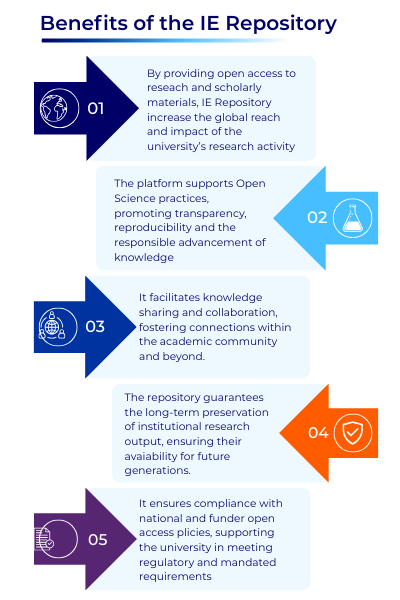
The IE Repository supports compliance with the European policies and initiatives that promote Open Access, Open Science and the responsible dissemination of publicly funded research. As a trusted institutional repository, it facilitates the deposit, preservation and accessibility of research outputs in accordance with European requirements.
The IE Repository contributes to compliance with the Spanish legal and policy framework for Open Access and Open Science, ensuring the dissemination, preservation and accessibility of research outputs produced by the university community.
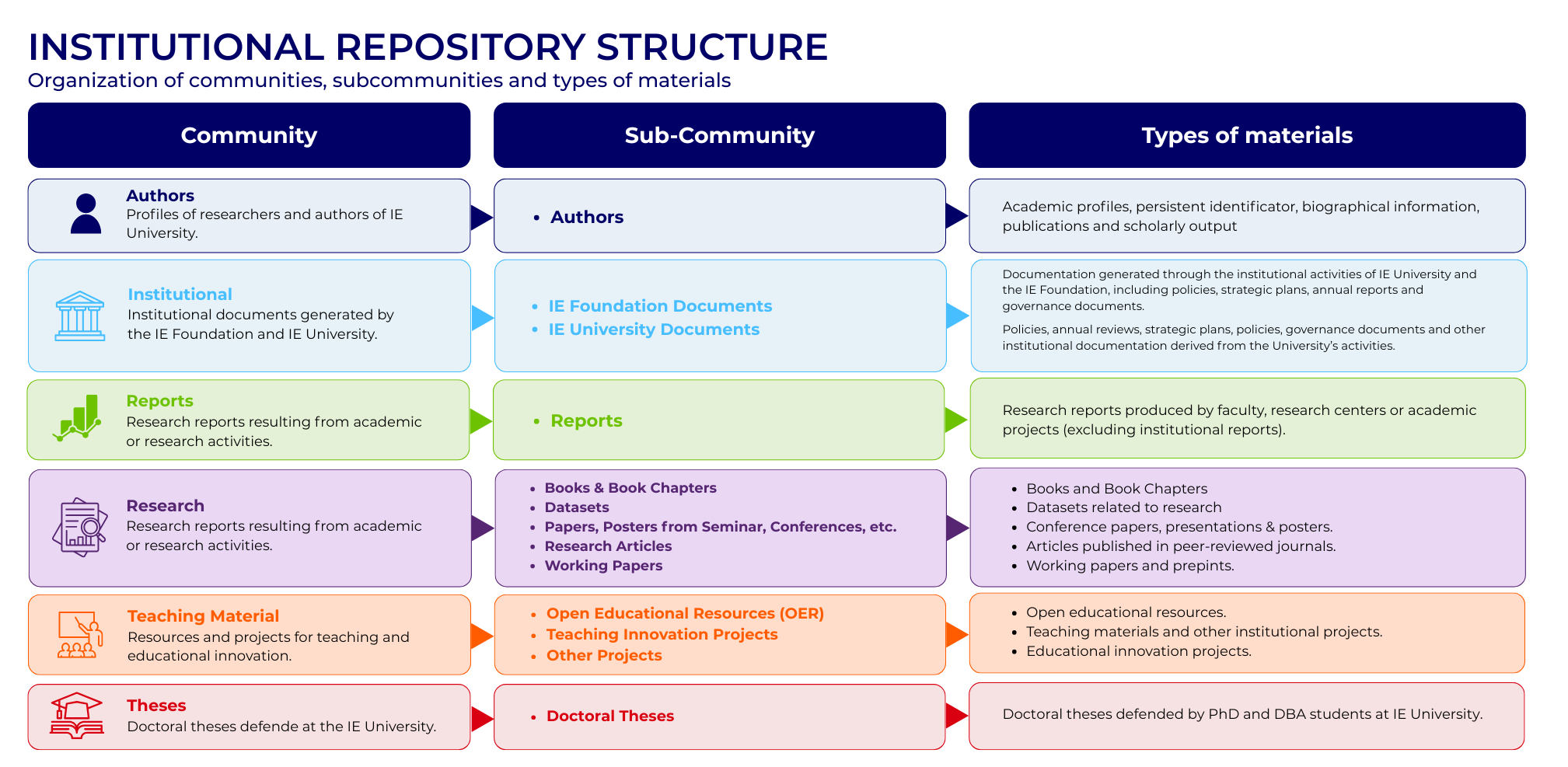
The Institutional Repository is organized into a hierarchical structure of communities and sub-communities that reflects the different areas of activity within IE University and the IE Foundation. The repository follows a document-type classification model, whereby materials are grouped according to their nature and purpose. This approach facilitates content discovery, management, and long-term preservation, while providing users with intuitive access to different types of scholarly, educational, and institutional outputs.
Authors
The Authors community contains profiles of researchers and authors affiliated with IE University. These profiles include biographical information, persistent identifiers, publication records, and links to the scholarly outputs associated with each author, providing a comprehensive overview of their academic and research activity.
Institutional
The Institutional community brings together documentation generated through the activities of IE University and the IE Foundation. It serves as a central repository for institutional records, governance documentation, and strategic information.
This community is divided into two sub-communities:
Reports
The Reports community contains reports generated through academic, research, and institutional activities. These materials provide access to research findings, project outcomes, and analytical reports produced by faculty members, research centers, institutes, and academic projects. This community serves as a dedicated space for reports that do not fall within traditional scholarly publication formats.
Research
The Research community contains the university’s scholarly and scientific output and is organized according to the different types of research materials produced by the academic community.
The community is divided into the following sub-communities:
Teaching Material
The Teaching Material community brings together resources developed to support teaching, learning, and educational innovation.
This community includes the following sub-communities:
Theses
The Theses community contains doctoral dissertations successfully defended at IE University. It includes PhD and DBA theses that represent original research contributions and form an important part of the institution’s scholarly record, ensuring their preservation, visibility, and accessibility within the repository.
Before depositing a publication in the IE Repository, researchers should check publisher policies to confirm which version may be shared and whether an embargo applies. The Open Policy Finder provides information on permitted manuscript versions, embargo periods and self-archiving conditions. The overview below explains the main publication versions: Preprint, Author Accepted Manuscript (AAM) and Version of Record (VoR), and their suitability for repository deposit. For assistance, please contact the repository team.
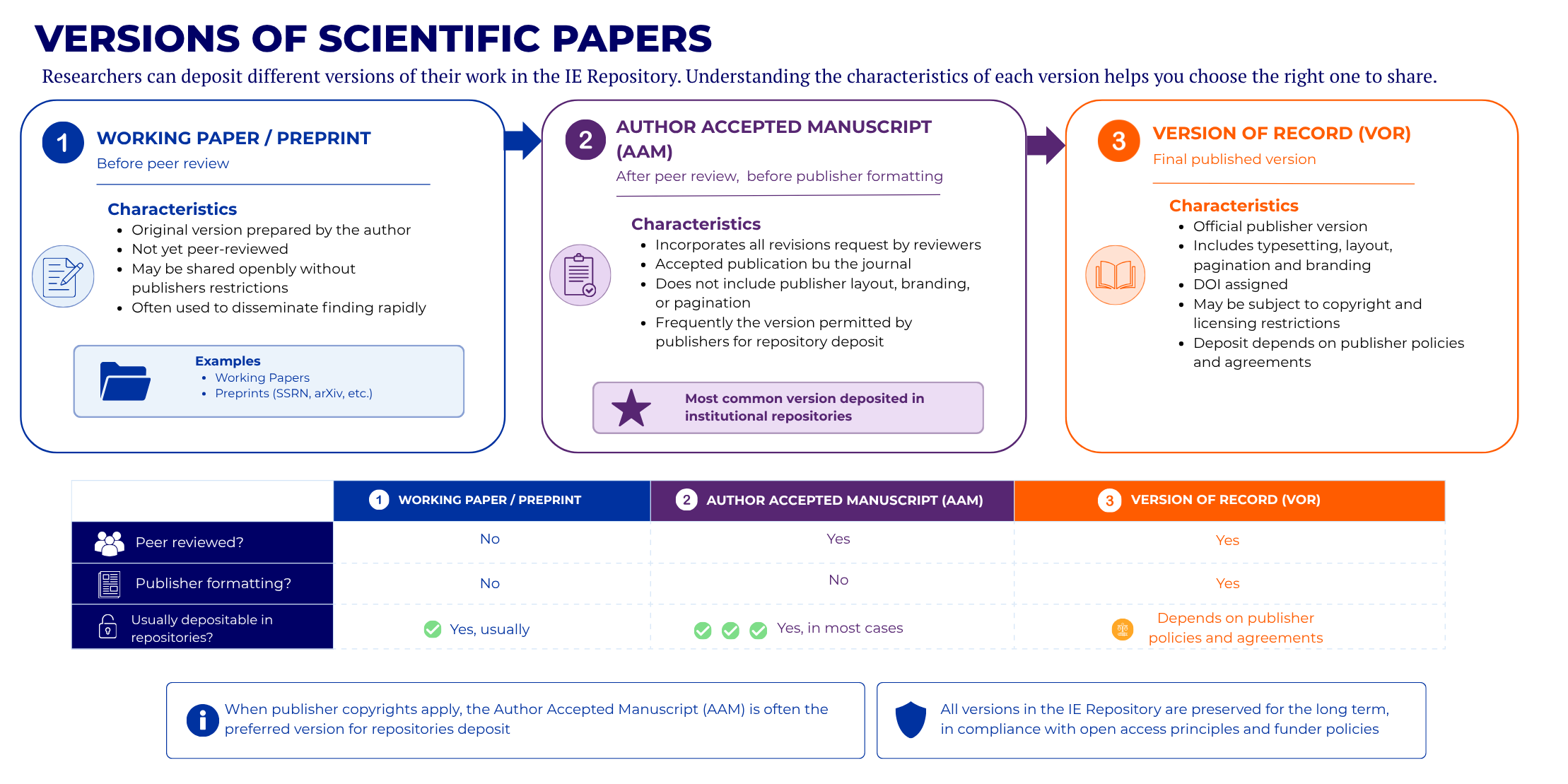
Scholarly publications go through several stages before reaching their final published form. As a result, different versions of the same work may exist throughout the publication process. Understanding these versions is important when depositing content in the repository, as publishers often establish specific conditions regarding which version can be shared.
Working Paper / Preprint
A Working Paper or Preprint is the earliest version of a research work. It is prepared by the author before the formal peer-review process has taken place and therefore has not yet been evaluated by external reviewers.
These versions are commonly used to share research findings at an early stage, receive feedback from the academic community, and accelerate the dissemination of results. Because they have not undergone peer review, they may differ significantly from the final published article.
Examples include working papers distributed through research centers and preprints shared on platforms such as SSRN, arXiv, or similar repositories.
Author Accepted Manuscript (AAM)
The Author Accepted Manuscript (AAM) is the version of a paper that has successfully completed peer review and has been formally accepted for publication by a journal.
This version incorporates all revisions requested during the review process and contains the final scientific content of the article. However, it does not include the publisher’s formatting, typesetting, pagination, logos, or branding.
The AAM is often the version most commonly permitted for deposit in institutional repositories and is frequently used to comply with open access requirements established by funders, institutions, and publishers.
Version of Record (VoR)
The Version of Record (VoR) is the final published version of a scholarly work. It is the official version released by the publisher and includes professional copyediting, typesetting, pagination, branding, and the assigned DOI.
While this is the definitive version of the publication, its deposit in institutional repositories may be subject to copyright restrictions, licensing agreements, or embargo periods established by the publisher. Researchers should therefore verify publisher policies before uploading a Version of Record to the repository.
Embargoes and Publisher Policies
Some publishers allow repository deposit only after a specified embargo period. During this time, the full text may remain restricted even though the record can be preserved in the repository.
Researchers are encouraged to consult the Open Policy Finder to verify publisher self-archiving policies, permitted manuscript versions, and embargo requirements before depositing their work. If assistance is needed, the repository team can provide guidance on copyright compliance and open access requirements.
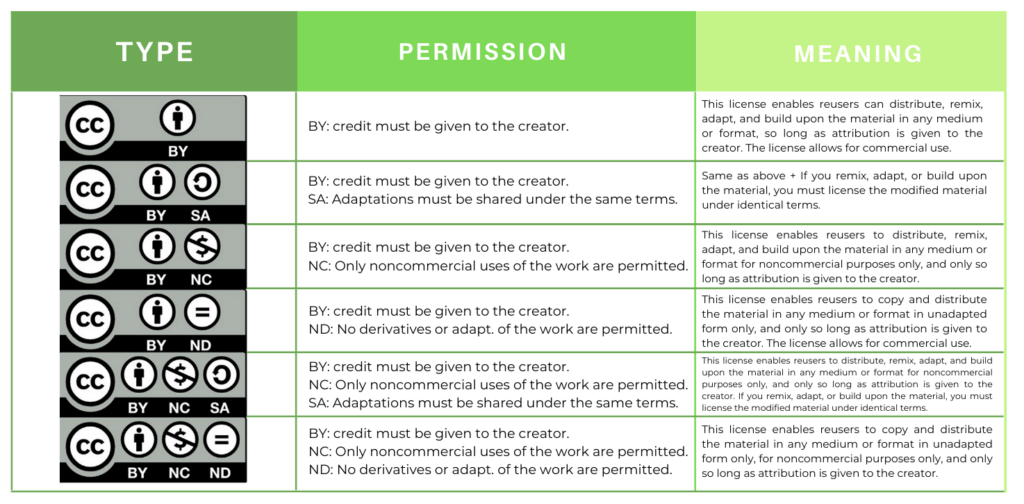
Creative Commons (CC) licences provide a standardized way for authors and publishers to specify how a work may be accessed, shared, and reused. All Creative Commons licences require attribution to the original creator, ensuring that authors receive appropriate recognition for their work.
The licence that can be applied to a publication is often determined by the journal’s open access and copyright policies. Researchers are encouraged to consult the Open Policy Finder before depositing their work to verify publisher requirements, permitted manuscript versions, embargo periods, and licensing conditions.
Policy Compliance
All submissions are reviewed to ensure compliance with repository policies, copyright requirements, and publisher agreements.
Metadata Review
Repository staff verify and, when necessary, enhance descriptive information to improve the quality and discoverability of repository records.
Publication
Once approved, items are assigned to the appropriate collection and published in the repository. Embargoes may be applied when required by publisher or funder policies.
Support
For assistance with submissions, copyright, open access requirements, or repository services, please contact the Open Access Office at openaccess@ie.edu. We’re here to help!