

“An inclusive construct that combines diverse movements and practices in order to make scientific knowledge openly available and accessible to all, as well as reusable by all, increasing scientific collaborations and the exchange of information for the benefit of science and society , and the processes of creation, evaluation and communication of scientific knowledge are opened to social agents beyond the traditional scientific community.” (UNESCO, 2021)
“Open science is an approach to research based on open cooperative work that emphasizes the sharing of knowledge, results and tools as early and widely as possible. It is mandatory under Horizon Europe, and it operates on the principle of being ‘as open as possible, as closed as necessary’
(European Commission)

Main statements:
Spanish statements:
Responsible research and innovation (RRI) has emerged as a science policy framework, which seeks to align technological innovation with broader social values, and to support the institutional decisions concerning the goals of research and innovation in conditions of uncertainty and ambiguity. This way, RRI aims to engage publics and responsible actors in the science and innovation field to produce ethically acceptable, sustainable and socially desirable research and innovation outcomes.
Over the last decades many efforts have tried to reduce the distance between science and society, leading to a European-wide approach in Horizon 2020 called Responsible Research and Innovation. RRI seeks to bring issues related to research and innovation into the open, to anticipate their consequences, and to involve society in discussing how science and technology can help create the kind of world and society we want for generations to come.
A normative framework for RRI includes different policy keys, which include values of the “Science with and for Society” objective of Horizon 2020.
Those policies are:
Currently, the RRI principles are widely present across the EU and beyond and are in fact embedded within key science policy issues as the Grand Societal Challenges proposed by the EC and within the vision of Europe for the future presented through the “Three Os” (Open Innovation, Open Science and open to the World).
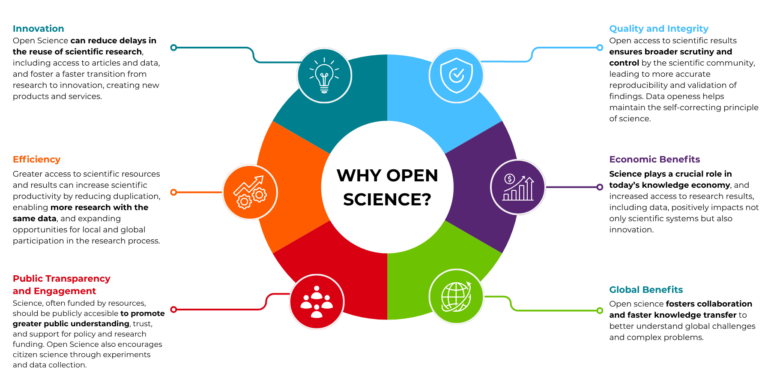
Open Science can reduce delays in the re-use of scientific research including articles and data, and promote a swifter path from research to innovation to produce new products and services
Greater access to scientific inputs and outputs can increase scientific productivity through reducing duplication, allowing more research from the same data and multiplying opportunities for domestic and global participation in the research process.
Science, often publicly funded, should be publicly accesible to promote a greater awareness among citizens and to build public trust and support for public policies and investments in research. Open Science also promotes citizen science in experiments and data collection.
Open Access to scientific outputs allow for greater evaluation and scrutiny by the scientific community which means more accurate replication and validation of research results. Openness to data contributes to maintain science’s self-correction principle
Science plays a key role in today’s knowledge economies. Increased Access to research results, including data, can positively impact not only in scientific systems, but also innovation.
Open Science promotes collaborative efforts and faster knowledge transfer for a better understanding of global challenges and communal problems.
Open Science is based on several complementary practices that promote transparency, collaboration, accessibility, and the reuse of research outputs. You can read each component below.
Open Access (OA) provides free and unrestricted access to scholarly information and other digital resources, including publications, datasets, software, multimedia, and educational materials.
A publication is considered Open Access when:
Open Source refers to software whose source code is publicly available under an open licence, allowing anyone to use, study, modify, and redistribute it.
Within Open Science, sharing source code alongside research data and documentation improves transparency, reproducibility, and collaboration.
Open Data refers to data that can be freely accessed, reused, and shared by anyone. To maximise their value, research data should also follow the FAIR Principles.
FAIR Principles:
FAIR principles ensure that research outputs can be discovered, understood, exchanged, and reused by both people and machines.
Open Educational Resources (OER) are freely accessible teaching, learning, and research materials released under open licences that allow reuse, adaptation, and redistribution.
Citizen Science involves the active participation of members of the public in scientific research.
Citizen Science promotes scientific literacy, public engagement, and the co-creation of knowledge.
Open Evaluation promotes transparent and inclusive approaches to research assessment. It encourages the recognition of a broader range of research outputs and activities beyond traditional publication metrics.
Open Peer Review increases transparency in the peer-review process while maintaining scientific quality and rigor.
Open Infrastructure refers to the shared technologies, platforms, repositories, standards, and services that support Open Science.
By providing open and interoperable infrastructure, researchers can more easily access, share, preserve, and build upon scientific knowledge, fostering collaboration and accelerating discovery.